A shift has occurred in Xylor Jane’s painting practice. Several years ago, she stopped using dots of paint to form grids of numerals and abstract patterns. This decision was tied to her body in several ways. Years of painting tiny dots while using high powered magnifying glasses caused her to develop vertigo. She also ran out of numbers she was interested in painting, something she never imagined she’d live long enough to see, which is believable based on the tomes of lengthy numbers she accumulated in dogeared notebooks. Jane’s project was a painted mediation on her own mortality; mapping her imagined lifespan often down to the second. This new body of work finds her in a different place altogether, set loose from the strictures of calendars and patterns, working without a net in new territory.
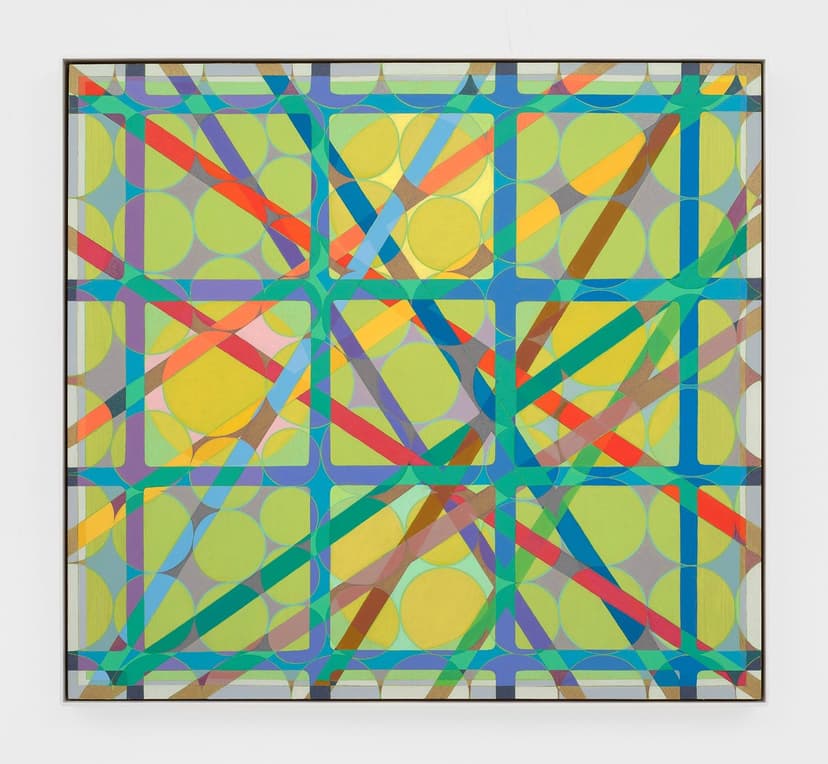
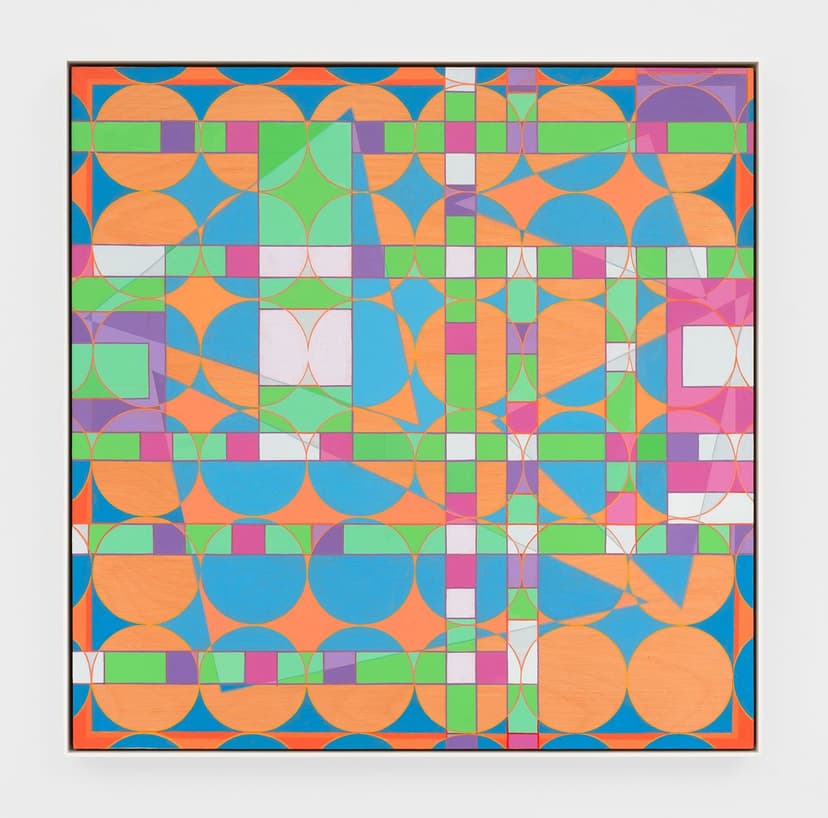
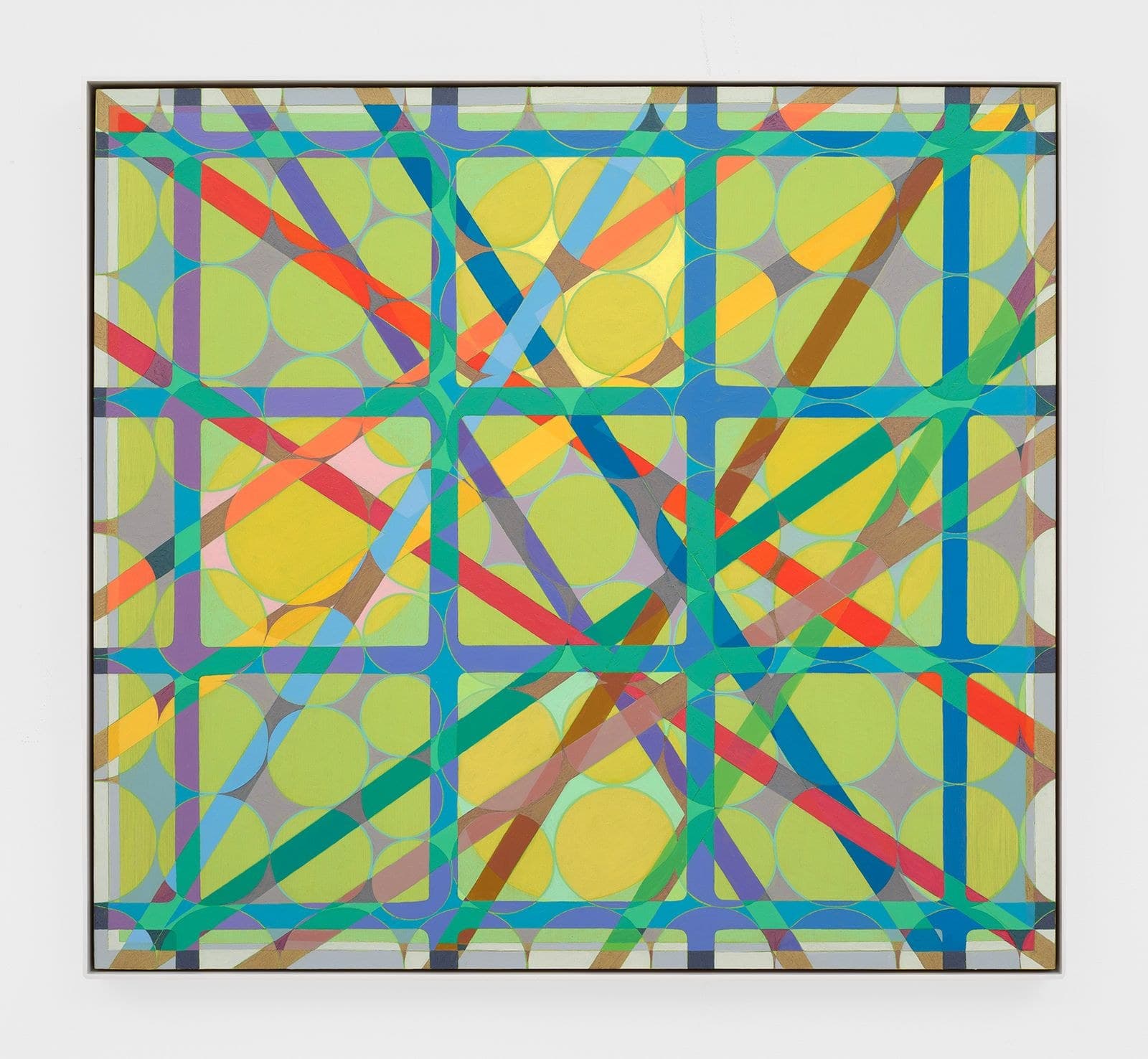
Jane overlays several grids creating a vertiginous effect as two or more seemingly stable graphic systems collide. It’s hard to know what to trust in the paintings as Jane plays with our expectations of solidity and air. Consider John Jack, 2026, a painting that employs several linear systems simultaneously. In it, Jane quotes a 22-inch square passage from Mondrian’s Broadway Boogie Woogie. Mondrian’s sampled grid is overlayed with another grid of circles while an embellished border surrounds the whole composition. The piece has several depictions of scotomas (blind spots), which are Jane’s effort to paint a strange ocular phenomenon she occasionally experiences, which present as washed-out sections on the painting. Despite the complexity, the work is bold and forthright, with satisfying “eye feel” as Jane puts it.
The grid has become the content of the work, not a merely a scaffold for marks and shapes. Jane is in command of the pictorial pressures she creates, but there are surprising moments that defy planning. At nexus points where grids overlap, moments of exquisite intricacy bloom, tender fractals emerge from Jane’s colliding grids that are brought to life through Jane’s present and attentive hand. Colors are chosen as homages to specific people in her life, based on her perception of the palettes they embody. They serve as forms of portraiture, thus the title: Paintings for People. Of course, the invitation is for all people as the generative quality of the works folds in anyone willing to look.
In the European Humanist tradition, the melancholic is associated with geometry. Albrecht Durer’s etching Melancholy 1, 1514 is an allegorical portrayal of the artist at work. At the feet of a vexed winged angel tools are strewn on the ground. To think of artists as melancholic is to express the difficulty of living and experiencing through making; suggesting that artists are aware that as they pursue their work the eternal clock pursues them. Durer’s angel, with drafting tool in hand, looks past the earthy things in front of her; a rainbow, skinny dog, ladder, a grid of magic numbers, and stares intently at a large abstract geometric form. The intensity of Jane’s vision, her pursuit of exploring and inventing geometric forms is similarly profound. To link painting, time, and mortality is old hat, but Jane has found an offramp of sorts; where reason, sentiment, visuality and chance run free.
Xylor Jane (b. 1964, Long Beach, CA) lives and works in Greenfield, MA. Jane attended the now-closed San Francisco Art Institute in the early 1990s. Her work has been exhibited in solo exhibitions at the University Museum of Contemporary Art, Amherst, MA; Santa Monica Museum of Art, Santa Monica, CA; Brandenburgischer Kunstverein, Brandenburg, Germany; UC Berkeley Art Museum & Pacific Film Archive, Berkeley, CA; CANADA, New York, NY; Konrad Fischer Galerie, Berlin and Düsseldorf, Germany; Parrasch Heijnen, Los Angeles, CA; Campoli Prest, Paris; Almine Rech, Paris; and Four, Dublin; among others. She received her BFA from SFAI in 1993.