Zach Lieberman makes photographs of math.
The works begin with observation. Lieberman studies the ways light interacts with different materials, from metal and lenticular lenses to iridescent film. He translates these observations into code, where behaviors can be exaggerated, combined, or pushed beyond what physical materials allow.
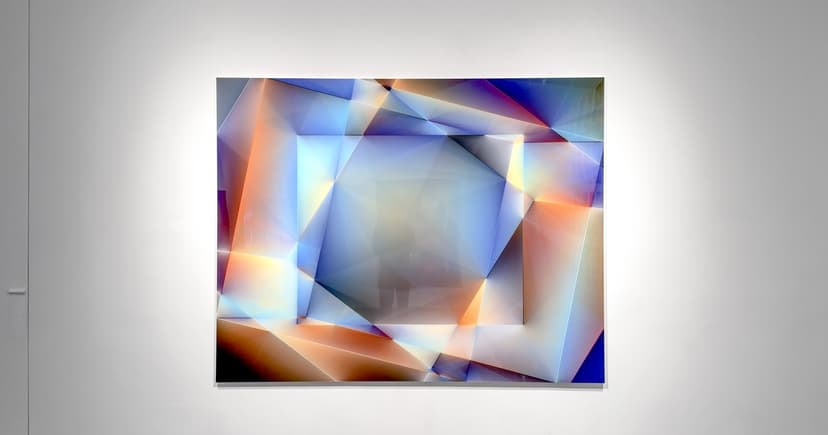
The geometry is simple: lines, grids, boxes, and curves. The complexity comes from how light interacts with these forms. Here, light takes on qualities of a physical material. It appears to have edges, volume and weight, without solid boundaries. It leaks and blends. Light becomes the object itself.
The eye completes the work. Some of what we see comes from the image itself, and some from our own perception: vibrating edges, colors that seem to separate, and forms that linger like afterimages. These effects aren’t just part of the image. They happen as we look.
For more than a decade, Lieberman has maintained a practice of making daily sketches in software. Across thousands of experiments, ideas recur, mutate, and branch into new directions. The fifty-six smaller works offer a glimpse into this ongoing process, while nine large prints bring selected experiments to a new scale and a series of animations unfolds them over time.
Abraham Palatnik and Gottfried Jäger offer important historical precedents. In the 1950s, Palatnik used mechanical systems to compose light, color, and movement. In the 1960s, Jäger used photographic rules to make images without depicting the visible world. Like these artists, Lieberman uses systems to shape light, but computation allows him to go further: rewriting the very rules that govern its behavior.
A photograph records light from the physical world. These works record light that never existed, behaving in ways real light cannot. Each work is an investigation of what light could be.
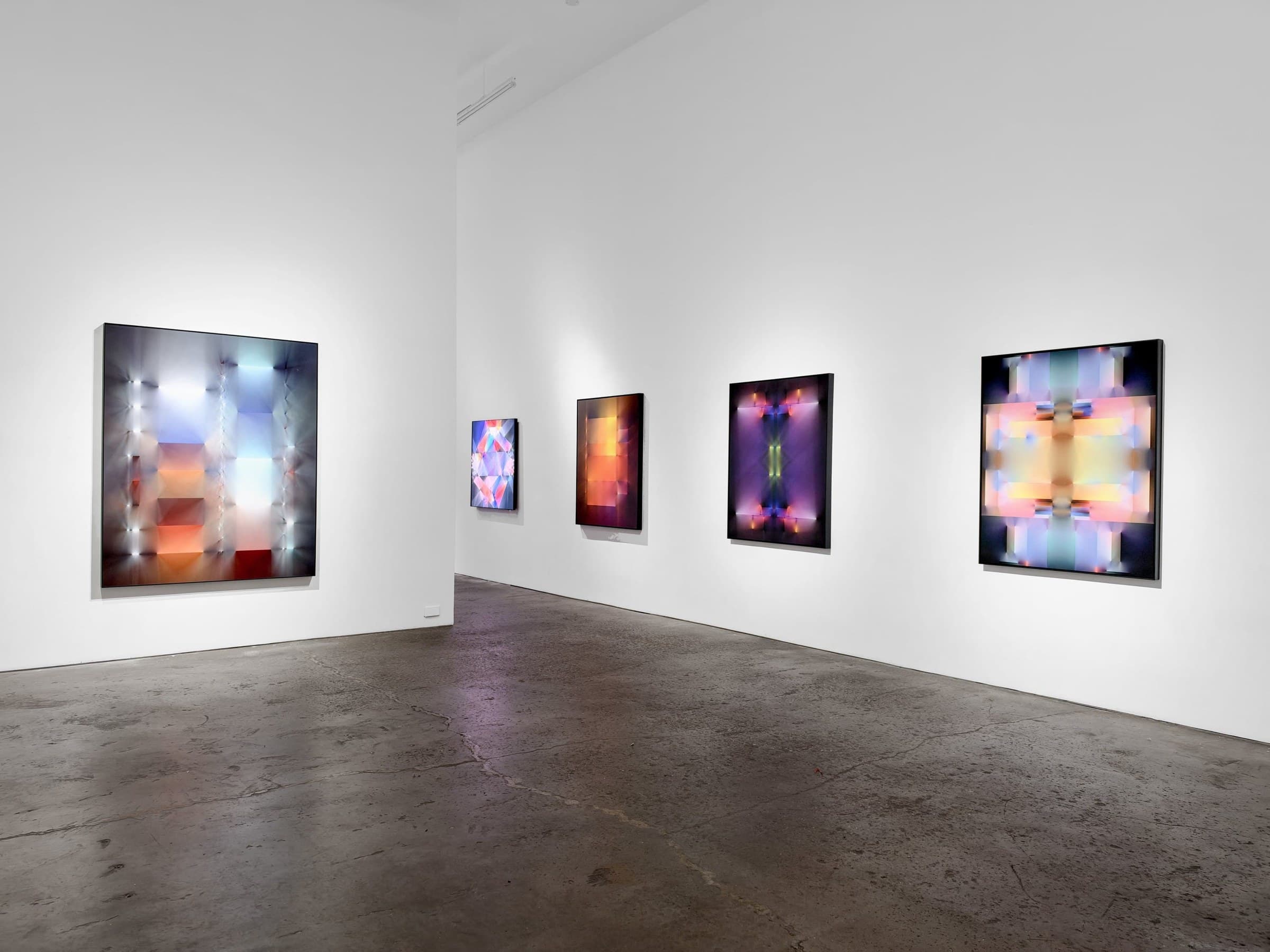
9 large-scale unique prints form the core of the exhibition.
Each begins with simple geometric shapes that emit light – lines, grids, curves – and explores how light transforms the field around them.
Light takes on the quality of something solid here. It appears to have edges and weight, stacking into bars and slabs, and casts shadows. Yet it refuses to stay contained. It leaks through its own edges, blends where colors meet, and pulls apart at the ends of lines.
At this scale, the light becomes an object in the room.
Unique archival pigment print, face mounted to museum acrylic, dibond back mounted and float framed in matte black painted hardwood, label signed on verso + Ethereum token
Unique archival pigment print, face mounted to museum acrylic, dibond back mounted and float framed in matte black painted hardwood, label signed on verso + Ethereum token
Unique archival pigment print, mounted and float framed in matte black painted hardwood, label signed on verso + Ethereum token
These animated works set Lightfield forms in motion.
Lines gather into surfaces. Shapes fold, split apart, and come together again. Colors drift and separate. What seems solid in one moment is fluid in the next.
The prints capture a single arrangement. The animations show how the systems behave and unfold over time.
56 unique prints, each 20 x 16 inches, come from Lieberman’s daily sketching practice.
Some came out of the same mathematical rules and arrived at very different forms. Others vary by just a small change: a shifted angle, a different curve, an adjustment to how light bends or accumulates.
Each stands on its own, but together they reveal an ongoing process of exploration in code.
Zachary Lieberman is an artist, researcher, and educator who creates artwork with code, exploring how computation can be used as a medium for poetry. He’s been listed as one of Fast Company’s Most Creative People and his projects have won the Golden Nica from Ars Electronica, Interactive Design of the Year from Design Museum London as well as listed in Time Magazine’s Best Inventions of the Year. He creates artwork by writing software and is a co-creator of openFrameworks, an open source toolkit for creative coding and helped co-found the School for Poetic Computation, a school examining the lyrical possibilities of code. Lieberman is also a professor at MIT’s Media Lab.
His daily sketches are not to be missed: @zach.lieberman