Six featured shows inside half a kilometre. Ryan McGinley at Deitch, Keith Haring on White Street, Harmony Hammond's rusted canvases. The densest featured run in the city.
Jeffrey Deitch, Wooster Street
Ryan McGinley: Night Shift presents photographs shot between 9pm and 5am across all five boroughs through spring into winter 2025. Employing slow shutter, long lens, and radio flash, McGinley creates luminous, hallucinatory scenes in which bodies and city become one — neon, halogen, and brake lights painting airy compositions that evoke pulsation and dance. Recoding the raw spontaneity of his early practice into a nocturnal New York, the series moves through locations of personal resonance: waterfront piers, smoke-spilling manholes, graveyards opening onto skylines, the Cyclone at Coney Island. "This is my poem to New York City," McGinley says — a place where rare quietness reveals itself as a playground for a body in motion.
Jun 13 - Aug 8
Luhring Augustine
A group exhibition at Luhring Augustine Tribeca curated by artists Salman Toor and Doron Langberg, bringing together twenty-two artists working across media, including Manal Abu-Shaheen, Komail Aijazuddin, Huma Bhabha, Hugh Hayden, and Jordan Nassar. Channeling the lyricism of painting alongside objects, textures, and moving images, the works visualize and contend with a fraught moment of collapsed trust. On view June 26 through July 31, 2026.
Jun 26 - Jul 31
125 Newbury
David Byrne and Saul Steinberg: Influence and Affinity places drawings, watercolors, prints, and collages by Steinberg in conversation with drawings and never-before-seen banner works by Byrne, tracing a shared sense of wry humor, sharp observation, and expansive creativity across generations. Steinberg — the major artist-philosopher of the 1940s and 50s, whose New Yorker covers transformed signs and symbols of modern life into something surreal — is cited directly by Byrne as an inspiration: "I realized some things might be able to be expressed better in a drawing rather than a song." Byrne's new textile banners, echoing the iconography of fraternal organizations with vintage trims and hand embroidery, make their debut alongside pandemic-era drawings and Steinberg's landmark cityscape suite.
May 28 - Aug 1
60 White St
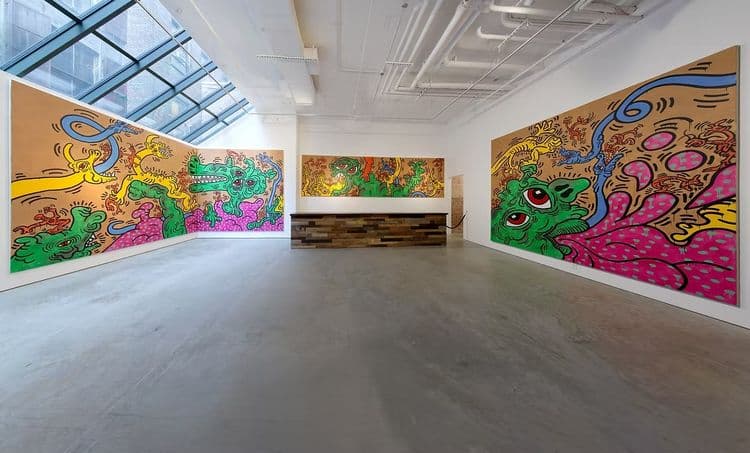
Keith Haring: A World in Motion traces Haring's practice as a form of global exchange, bringing together works created across New York, Tokyo, Paris, Milan, and San Francisco to examine how he translated downtown New York's energy into a visual language that traveled across cultures. Curated by Carlo McCormick, the exhibition foregrounds movement as central to Haring's life and work — from subway chalk drawings that transformed the city's underground into an exhibition space, to collaborations with Andy Warhol, Bill T. Jones, and Grace Jones at Paradise Garage. His art entered into dialogue with each place it encountered, absorbing as much as it transmitted.
May 14 - Sep 8
Alexander Gray Associates
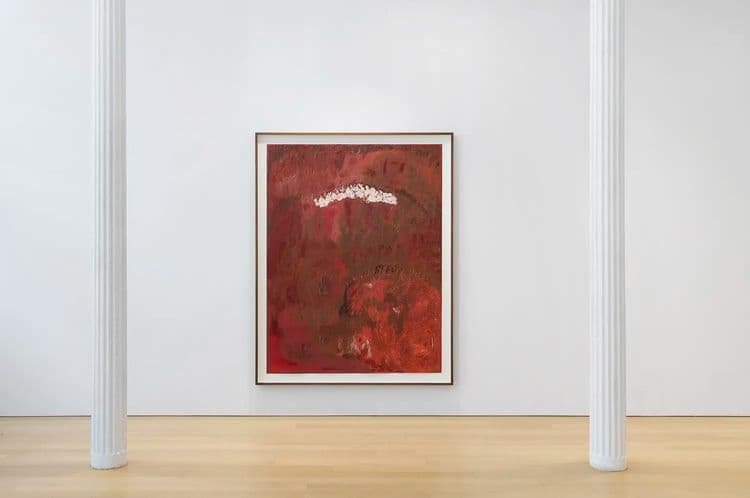
Harmony Hammond: Rust Never Sleeps presents large-scale paintings made within the last three years that continue Hammond's disruption of Minimalist abstraction with latent political content and charged material presence. Four canvases incorporate rusted stamped metal scavenged from abandoned buildings in the American Southwest, holding the history of dispossession alongside Hammond's signature grommet-studded, sutured, and overlapping painted canvas and burlap. A blood-stained crimson rectangle hangs like a warning in Red Flag; a lace-trimmed apron introduces oppositional domesticity in Attachments. Throughout, abstraction functions as a site for social meaning and the canvas as a stand-in for the body — entropy remaining generative, survival leaving its marks visible.
Jun 5 - Jul 24
Mendes Wood DM
Paracosms brings together Carlotta Amanzi, Carly Burnell, Ted Gahl, Mimi Lauter, Kristy Luck, Shane Rossi, and Peter Shear around imagination as a precise instrument — the inner room we never stop returning to, rendered outwardly visible through paint. Amanzi's oil and charcoal canvases hold earlier states legible beneath later ones; Burnell layers atmosphere through oil, wax, and resin until landscape becomes a presence of absence; Luck lets organic forms surface and recede, honoring a matrilineal inheritance severed by the Sixties Scoop; Lauter treats the garden as sacred theatrical space; Gahl builds dense all-over surfaces where mineral and growth are indistinguishable. Seven distinct idioms, one constancy: interiority made transmissible
Jun 5 - Jul 31